SATURN3 early-career researchers selected for the “Rising Stars” Event of the German Federal Ministry for Education, Research, Technology and Space
Author: SATURN3 consortium
On 28 October 2025, we (Saturn3 PhD candidate Abir Hussein from Regensburg, postdoctoral researcher Lennart Versemann from Göttingen, surgical resident Karl Knipper from Cologne, and postdoctoral researcher and scientific project coordinator of Saturn3 Vivien Ullrich from Essen), had the exceptional opportunity to participate as one of only 40 selected early-career researchers from across Germany in the “Rising Stars” event organized by the Federal Ministry for Education, Research, Technology and Space (BMFTR) in Berlin.
Federal Research Minister Dorothee Bär opened the program by emphasizing that “networking is the key to success.” Her message highlighted the importance of collaboration across disciplines, fields of expertise and generations, which we experience firsthand within our Saturn3 project.
Participants engaged in a series of workshops that addressed key competencies required for producing high-quality, impactful scientific work. The session on patient participation emphasized the crucial role that patient involvement plays in enhancing research quality and ensuring societal acceptance. We learned how participatory elements can be meaningfully integrated into research planning and implementation, allowing patient perspectives to be incorporated in a structured and impactful way. The workshop on science communication highlighted its decisive role in translating research findings for broader audiences. Participants learned concrete strategies for presenting complex scientific information clearly and in ways that engage diverse target groups. In the workshop on third-party funding, we received valuable guidance on developing competitive funding proposals. Practical insights were shared on how to structure grant applications, formulate objectives, and navigate the process of securing external funding – skills that are essential for conducting research projects successfully and sustainably.
A particular highlight for us was the “Coffee with Experts” format, which created an informal yet inspiring setting for conversations with established researchers and patient representatives. These exchanges offered not only professional inspiration and invaluable insights, but also meaningful guidance for shaping future career paths in research. Engaging directly with experts provided a unique opportunity to learn from their experiences and to build connections that may evolve into future collaborations. One of the experts we had the pleasure to speak with was our Patient Advisory Board member Cindy Körner, Spokesperson Patient Research Council NCT Heidelberg and Patient representative.
Another highlight for us was the panel discussion “Failure Allowed – Learning from Setbacks,” in which experts shared how mistakes and dead ends can spark innovation and personal growth. This open and honest dialogue encouraged us to view setbacks not as obstacles, but as opportunities for learning and development.
The day concluded with a dinner on the Spree, where Parliamentary State Secretary Matthias Hauer emphasized that we are all in the same boat, steering together toward progress in cancer therapy.
Overall, the Rising Stars event was an enriching and motivating experience. The knowledge gained, the perspectives exchanged, and the connections established will strongly support our ongoing work in Saturn3 and contribute to our professional growth within the scientific community. We are really thankful that four of our young Saturn3 scientists were selected for this unique event that provided valuable impulses and offered an inspiring opportunity to deepen our expertise and build meaningful professional networks.
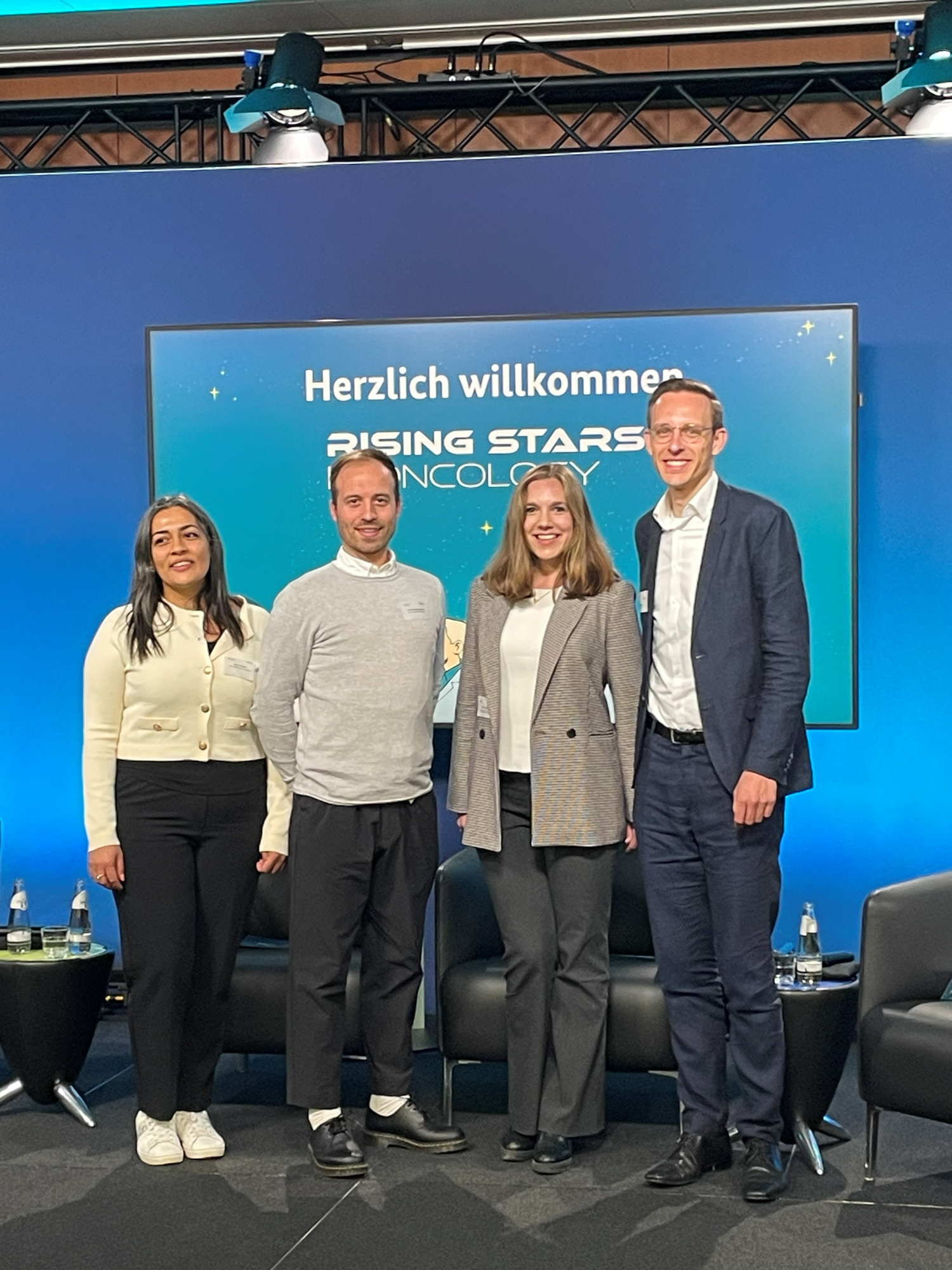
Left to right: Abir Hussein from Leibniz Institute for Immunotherapy in Regensburg, postdoctoral researcher Lennart Versemann from the University Medical Center Göttingen, postdoctoral researcher and scientific project coordinator of Saturn3 Vivien Ullrich from the University Hospital Essen and surgical resident Karl Knipper from the University Hospital Cologne.